-
We have to break down the silo mentality of inside/outside dept; relevant/irrelevant curric. https://t.co/uhSIN73Nu7 https://t.co/2OZwAhvGIU
-
The Remains of the Day by Kazuo Ishiguro – a subtle masterpiece about what is not said https://t.co/76ZFgBsvPq
-
My take on Go Set a Watchman – Lee wanted to write
My take on Go Set a Watchman – Lee wanted to write adult book, wrote children’s book instead https://t.co/PMhSeMpZYq #GoSetaWatchman
-
With Stories We Defeat Our Inner Moriarty – my ta
With Stories We Defeat Our Inner Moriarty – my take on the latest episode of Sherlock https://t.co/986VPHRcCW #Sherlock
-
Jenn Hanson • Hour of Code, Math Maker Week, and More Book Speed…
The library was busy in December! https://t.co/QiAn60Zo9X #tlchat #istelib @WorcesterAcdmy
Diigo Links (weekly)
-
How Kwame Alexander Gets Teens Reading and Writing Poetry | School Library Journal
How Kwame Alexander Gets Teens Reading and Writing Poetry https://t.co/Np5Y9ObfBH
Diigo Links (weekly)
-
Trump is Yeats’s rough beast, succeeding because the center cannot hold https://t.co/2SAKLt8dol #Trump
-
. and many others share their favorite poems. htt
.@tanehisicoates and many others share their favorite poems. https://t.co/p0FrVxfwDp https://t.co/IA5u4HYTZ5
Slice of Life #20: I Have Anxiety
 I have anxiety. It makes me sad for my family, and it makes me sad for me because it has prevented us from doing things. Fun things like taking day trips. It has made doing these kinds of fun things hard for me. The reason anxiety causes me so much trouble is that in my particular case, it’s my car that makes me anxious.
My car is getting rather long in the tooth, and it’s had some hard to diagnose issues over the years. The first time we had trouble with it was in the middle of nowhere on a road trip from Georgia to Massachusetts—a vacation. We broke down in the middle of Pennsylvania. We had been stuck in traffic, and though I was driving, I hadn’t noticed the engine running hot until the alarm started to go off. Right after that, steam poured out from under the hood. I pulled over as best I could, and we called AAA. We were waylaid for about five hours with two children on the autism spectrum and nothing to do, really, until the car was fixed and we could continue on to Salem. I was terrified that the mechanic would just about rob us. You really are putting your trust in people when you’re in a situation like that.
I had had plenty of car issues in the past. Once, I was pregnant and had two children with me, and I didn’t have a way to call anyone, so I was walking up the interstate toward a gas station. Some nice guy took pity on me (I was rather pitiful, hugely pregnant and pulling two small children along) and drove me there. Once when my oldest was a baby, I got out of the car to take her in to daycare. I was running late. And green liquid started pouring out of the car. My point is that this anxiety issue grew over time, but it didn’t become debilitating until this car, mainly because we can’t really seem to figure out why it has problems sometimes and doesn’t have problems other times. So I have this feeling of distrust where the car is concerned.
Rationally, the very worst thing that could happen is that it would break down and need a tow. I could still get home. It would be okay. It has been okay before. I also know that right now, if something like that happened, we could afford the repair. No one would be harmed. It would be an inconvenience. That’s all.
I can actually go long stretches when the car has been fine for a while and not be too anxious. I even drove it the other day. Dylan needed a Star Wars tee-shirt for school, and because of his communication issues, we didn’t realize what he wanted until about 10:30 at night, so I got in the car, went to Walmart, and bought him one. I was gripping the steering wheel the whole time.
The issue that we have, and it’s intermittent, seems to be that when the car is fully warmed up, it tends to, and excuse my precise mechanical description here—FREAK OUT—when it’s at a stop. It used to start to overheat. It doesn’t do that anymore, but the oil light flashes. I think I know what the issue is because I have Googled it, and it’s not a terribly bad one. We have had it in the shop, and it works okay for a while, but the frustrating thing is we can’t seem to figure out why it does it so we can fix it once and for all. And it doesn’t even do it very often or even kind of often. It’s an extremely rare issue.
The car was acting up a bit last Friday when Steve came to get me after school. I tried to be calm, but I started shaking and my heart was pounding. I was starting to have an anxiety attack. Ever since Friday, I’ve been a bit of a wreck in the car. Let me tell you what I have done to avoid driving. I walked to the grocery store in the rain today. It was okay. It was actually nice. But I got wet, and the store is about seven tenths of a mile away. It’s not a bad walk. It doesn’t take very long. But it takes maybe five minutes to drive, and I don’t have to carry bags home. But walking doesn’t make me anxious.
Tonight, Dylan’s school was able to get us tickets to an autism-friendly production of A Christmas Carol. Dylan was excited. I was nervous to be in the car because I knew that it would be some stop-and-go traffic, and we might have to wait at lights. When it looked like it might take us a while to get into the parking garage at the theater, I could feel a full-on attack coming. I was already twisting my wallet in my hands. I was shaking. I felt tears coming on. So I apologized and asked if I could get out and wait while they parked. My husband is very understanding. Way more than he should be, given how little sense it makes. Because my rational mind knows that everything is really okay, I wasn’t worried about the family in the car. I was worried about being in the car myself and making everyone else worried and miserable. On the way back, we weren’t able to go out to eat because I was too anxious in the car. And it was completely fine. Nothing even happened.
I have avoided gatherings with friends because of transportation issues. I have walked when it wasn’t easy or convenient rather than drive. Last summer, when I was going to AP training in a town that is literally maybe a half hour away, I arranged to stay in the dorms and even to stay an extra night so I could travel by bus. I could easily have commuted each day and spent evenings with my family if not for my anxiety. The machinations I have to go through to go anywhere require a great deal of time and planning.
We are saving for a new car, and we should be able to get one soon. One thing I’m very thankful for this Christmas season is that my husband has been blessed with two big freelance writing gigs that will allow us to be able to buy a new car at last. I think the anxiety about the car will improve after I have a car that is reliable, dependable—new. I don’t expect it will vanish, but on the occasions when I’ve rented cars (yes, I’ve rented cars when traveling in-state because I’ve been afraid to drive my car any substantial distances), I haven’t been anxious.
The thing with anxiety is that I’ll probably find something else to fixate on. I actually do get anxious about other things (though the car is the only thing that drives me into full-on anxiety attack mode). I’m not sure what I’ll transfer the anxiety to. But I am hoping that being able to remove this one major source of anxiety from my life soon will offer me some freedom. Maybe I can go exploring. Maybe I don’t have to turn down invitations. Maybe I don’t have to feel bad about asking to carpool.
Given that an anxiety attack was the low point of my day, and also that I feel very embarrassed and sad about it (especially for my family), I was a bit scared to write about it. On the other hand, it’s not just the low point of my day today. It’s the low point of too many of my days. It’s a frustration that I know others share and can identify with. And since it does embarrass me so much, I don’t talk about it. It’s a pretty big slice of my life today, though.
 Slice of Life is a weekly writing challenge hosted by Two Writing Teachers. Visit their blog for more information about the challenge and for advice and ideas about how to participate.
Diigo Links (weekly)
-
Book speed dating is getting competitive! Someone
Book speed dating is getting competitive! Someone just asked to check out all the books. #tlchat https://t.co/bTTrdgACeg
Slice of Life #19: “The Best Book I Ever Read”
Previous visitors might remember that I am implementing independent reading. Students have shared their reading progress for their first full week of independent reading. Almost all of them met their reading goals. A few observations:
- Most of the students are enjoying their books. One boy declared in class today that Kwame Alexander’s book The Crossover is the “best book [he’s] ever read.” He’s been recommending it to others. Another said of Miss Peregrine’s Home for Peculiar Children, “This is a really intense and fun book to read, the pictures in the book combine [with] the writing really well and make it even more interesting.”
- One student said he wasn’t enjoying his book, and I emailed him to let him know it’s okay to abandon it and move on. I think he just needed to know it was okay.
- One girl finished a project we’ve been working on and read for the entire 75-minute period today. And she told me at the beginning of the year that she didn’t like reading and didn’t read for fun.
- Some of them need to recalibrate their goals. I had them use Penny Kittle’s method of counting how many pages they can read in ten minutes, then multiplying that figure by six and then doubling it to determine how much they can read in two hours. Some of them didn’t factor in needing to look up words (I have many English language learners in my classes) in their time.
- One student emailed me to let me know her page count was proving unrealistic, so she recalibrated on her own. I like the fact that my students are doing this kind of thinking: adjusting their own goals and taking ownership over their reading.
- One student finished John Lewis’s graphic memoir March: Book One. He picked up March: Book II and checked out Winger for over the break.
My student who is reading The Crossover is an interesting student. He’s one of those real charmers, a leader in the classroom. The other students tend to look to him. He’s easily the most outgoing student in the class, so when he says a book is the best book he’s ever read, the others are going to add it to their list. He said he is close to finishing his book and will need another “to read over the break.” And I said, “Yes, of course, because I want you all to keep reading over the break.” He joked that he would cuddle up with the book and a nice cup of tea. I told him he was describing my idea of a party.
So far, the independent reading is quite a success. I am pleased to see the students reading so much. I’ve had a good time reading along with them (I haven’t done any reading conferences yet because at this time, I haven’t identified a need).
The students are already establishing the routine of reading at the beginning of class. I forgot to set the timer and remind them to read today in one class, and they started without me!
As I’ve promised before, I’ll keep posting updates about how independent reading is working. It’s off to a strong start.
Slice of Life is a weekly writing challenge hosted by Two Writing Teachers. Visit their blog for more information about the challenge and for advice and ideas about how to participate.
Diigo Links (weekly)
-
Educacioun ys preparinge for the worke of lyfe, na
Educacioun ys preparinge for the worke of lyfe, nat merelye a lyfe of worke.
-
Jenn Hanson • Book Speed Dating to Encourage Independent Reading
Adventures in book speed dating this week w/high school students: https://t.co/QqUTmeO23q #tlchat @danamhuff
Independent Reading Step 1: Selecting Books

On Thursday, I took my students to our library, and our Director of Library Services, Jenn Hanson, booktalked several titles. Next, students took 30 seconds to select a book from the clear plastic bins at each table (or grabbed one of the books she booktalked). Students read the books for four minutes, then gave the books a rating (whatever rating scale they wanted to use), and put the book back. Jenn called it “book speed dating,” and I think the students really liked it. We did four rounds, and typically, students had a book in mind that they wanted to read after that.
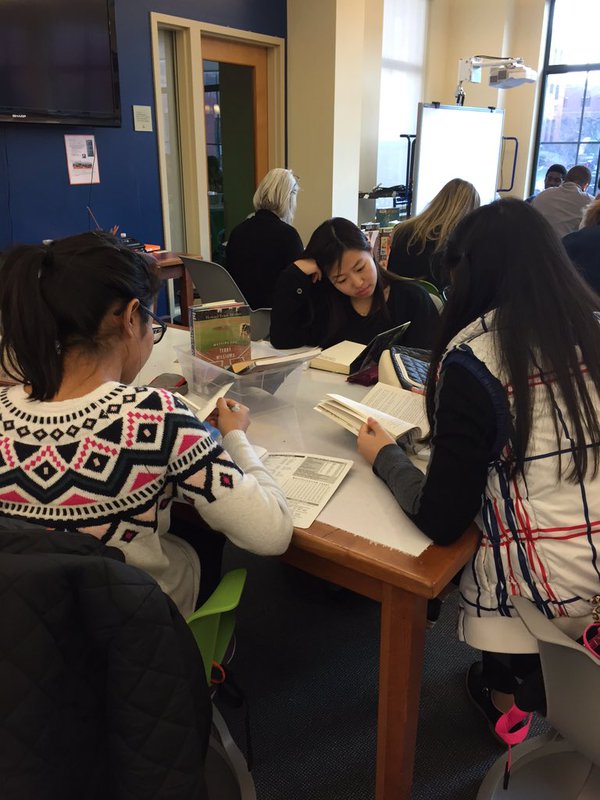
Students checked out books and we calibrated their reading speed. I asked them to read at a comfortable pace for 10 minutes. After that we multiplied how many pages they could read in 10 minutes by 6 to get the number of pages per hour, then doubled that number for the pages that could be read in 2 hours. I want them to read 2 hours per week at a comfortable pace.
In class the next day, there were some questions about pages. What if some books had poems and you could read them faster? Yes, that happens, so you need to recalibrate for the new book when you get it.

I participated too, and I was able to find several books to put on my own reading list. I had asked students to turn to the last page of their Reader’s/Writer’s Notebooks to make a list, and every student had several titles written down.
I didn’t notice any overt resistance. Everyone, even my students who describe themselves as non-readers, found a book. In class the next day, all but one of the students remembered to bring their books (and I happened to have had a copy of his book to lend him for class).
I booktalked Sherman Alexie’s The Absolutely True Diary of a Part-Time Indian the next day (only in one class because the other doesn’t meet again until Monday, at which time I’ll share the Alexie book with that class). I told students if it sounded interesting to put it on their list, and I notice that several students wrote the title down in their notebooks.
I also asked students to find one sentence that they really liked for some reason in their independent read and copy it down in their Reader’s/Writer’s Notebook then write one or two sentences about why they liked it. We all shared our sentences. I suggested that if someone’s sentence sounded interesting, students might want to write the title of the book it came from down as well.
The independent reading is off to an encouraging start. The students all chose great books, and Jenn was wonderful at engaging the students in selecting their books.
Updated 12/5/15 to add a link to Jenn’s post about our library visit on her blog.
Slice of Life #18: NaNoWriMo
 I participated in NaNoWriMo this year. I have participated in the past, and I have the start of three books I’d really like to return to one day as a result. I have only “won” one other time, however. This year, I decided I wanted to have a lot of fun, so I took a leaf out of Rainbow Rowell’s book and wrote a Harry Potter fanfic. A lot of people might consider writing fanfiction a waste of time, but the fact is that I did write over 50,000 words, and I had fun. Penny Kittle says in Book Love, “We all need more fun with writing. I’m serious about this. Play leads to good writing, and good writing begets better writing” (73). This advice came to me at a crucial point in the writing of my NaNoWriMo novel: the point at which was starting to feel like a dork for writing a fanfic. When I came across those three sentences, it was like receiving permission to be a dork, and in fact, to celebrate it because it would make me a better writer if I played a bit more. And it has. It seems like meeting a 1,000-2,000 word count goal is not the challenge it used to be. Some days, I could, in fact, knock out 2,000 words in a couple of hours. One mad day, I wrote 10,000 words.
So I am writing my Slice of Life post today about how happy I am that I won NaNoWriMo. I made myself write every single day, even when I didn’t feel like it. I made myself go over the required 1,667 words whenever it was feasible so I could have insurance for days when meeting that minimum was not going to happen. That turned out to be the best strategy because I went to NCTE so far ahead that I could get away writing very little those four days I was gone. But I still wrote every day.
I have no idea where my story is going, and at this point, crazy things are happening that I didn’t anticipate. It’s more or less like being possessed and just recording whatever it is that the characters do. And I have to admit that at first (until I started feeling bad), I was extremely excited, and what I was writing was good. Later, I started to feel less good about it, but it was okay because it was a fanfic, so a “shitty first draft” was permitted. What I learned from this experience is that I need to give myself permission to write shitty first drafts every time. I teach my students about the importance of process, but the truth about my own writing is that I want it to be perfect the first time. And that’s not how writing works, and I know it.
Slice of Life is a weekly writing challenge hosted by Two Writing Teachers. Visit their blog for more information about the challenge and for advice and ideas about how to participate.
Independent Reading
 I’ve been meaning to get around to starting independent reading in my classroom for years. Honest. But like so many things I’ve been “meaning” to do, I put it off. I did finally buy Penny Kittle’s Book Love back in June, and I fully intended to read it. It is true that I had a busier than normal summer. So busy it might in fact be called a non-summer. But I didn’t pick it up and didn’t pick it up. Right around mid-fall, I could feel that malaise creeping in. I’m not talking about the students. I’m talking about me. Then I went to NCTE, which always rejuvenates me and keeps me going for the rest of the school year. Once again, I heard the discussions about independent reading. Finally, something clicked. I think there is a statistic about how many times you have to be exposed to an idea before you pay attention to it. I decided to do it, and I decided not to wait until the second semester starts in January. We’re starting right now, this first week of December. Independent reading is finally going to happen for real in my classroom.
At the beginning of the school year, I ask students to write an educational autobiography for me. I want to know what school has been like for my students. I want to know about how they perceive themselves as students, as readers, and as writers. Almost all of my eleventh graders confessed they don’t like to read and do not read for pleasure. That’s a staggering statistic. They are not going to magically become life-long readers, which I say is one of my goals for them, if I don’t do something. I think the students in my class, the ones who say they don’t like reading, just don’t know what they like to read. They haven’t found a book yet. I will admit that I try some different things that make literature study more interesting for students. Literature circles, for example. One of my students confessed he had never read so far into a book as he had the book my students were reading in November, The Adventures of Huckleberry Finn. I attribute that stamina to the literature circle.
If I had ever been asked to choose my own books to read for pleasure in school, it would have been my favorite class ever, and those ten minutes or so at the beginning of the period would have been my favorite part of the day. But I was a reader, and I became a reader in spite of my teachers, not because of them. I don’t actually have memories of reading something I really liked in school (after elementary school, that is) until 11th grade, when we read To Kill a Mockingbird, but even in that case, I didn’t choose to read that book. It was assigned. I read my own things outside of school. I actually liked reading, and I didn’t enjoy the selections chosen by my teachers. Sometimes, I even faked my way through reading because I couldn’t keep up with the assigned reading. I didn’t want to fake it. I actually wanted to read the books. I even faked my way through one of the books I was assigned in college. Even though I didn’t always do my assigned reading, I actually really wanted to read and loved to read. If my students don’t love to read, think how much more they must be faking their way through reading. Sometimes, later on (never at the time), former students have confessed to me that they didn’t read a text I assigned.
I firmly believe no one is going to die if they don’t read a certain book. I know that feeling is pervasive in secondary education, but one reason I don’t share it is that I myself had such a patchy high school education that I managed to graduate and even major in English Education (which at my school, meant only two fewer English courses, before you complain it isn’t as rigorous as English) without having ever read such essentials as The Adventures of Huckleberry Finn, The Great Gatsby, The Scarlet Letter, and so many others. In fact, had I not read them on my own, I also would have missed The Catcher in the Rye and Lord of the Flies. Can you believe I’m still here to tell the tale? What happened was that I read all those books later. I actually think I read them at the perfect time for me to read them, too. So even though I love leading students through a work of literature and watching them enjoy it, I also want them to become readers, and I think this year in particular, my students need my help to figure out how to do that.
Enter Book Love. Though I’m not finished reading it yet, I already have some advice on how to start, which is what I really needed. I had several questions about how this should look, including what to grade and how to grade it. Kittle covers all of that ground in the book. I scheduled a visit to the library, and our librarian plans to book talk some titles so that my students can make their first selections. I have already begun the process of hauling my own books to donate to my classroom library. I even spent some time last week organizing the books on shelves. Once my library is big enough, I’ll organize it by genre, which I think will help students find what they want to read more quickly.
One thing I especially appreciate about Kittle’s approach is that she doesn’t recommend scrapping the literature study in favor of all independent reading. I find our discussions of the literature we read together to be rich and rewarding. I have heard a lot of teachers who seem to me to be ditching the full-class novel entirely in favor of independent reading, and I am not ready to do that at all. Kittle says the key is balance. We need to create life-long learners and build time for independent reading. But students also benefit from full-class novels. I actually don’t teach a lot of novels in my eleventh grade classes, so I think weaving independent reading into the curriculum should be fairly easy and shouldn’t strain my curriculum too much. But I say that if it does, then perhaps some texts need to go. I am here to serve the students, and that doesn’t mean cramming as much curriculum in as I can.
Other teachers at our school are trying independent reading with great success. It feels great to be in their classrooms, watching them conference with students about their reading and talking about books. As much as I knew independent reading was the right thing to do and as much as I wanted to do it, I somehow didn’t find the time to make it work. I think I just needed to hear one more time how important it is. Here we go. I’ll let you know what happens.