“To End Where I Begun”: Backward Design and Shakespeare

I am presenting at NCTE tomorrow morning at 9:30 at the Yacht and Beach Club in Grand Harbour Ballroom South. You can download and/or view all my session materials here.

Note: I think if you visit the presentation on SlideShare and download it, you can get the notes.

Here is my handout for my Macbeth performance task that I discuss as an alternative to a performance.

Here is a graphic organizer for my comparative video exercise for Act I Scene 1. I use the filmed versions of Macbeth directed by Jack Gold, Roman Polanski, and Geoffrey Wright for this activity.

Here is a Wordle made from the text of Macbeth that I use to introduce students to themes in the play.

Chris Shamburg’s radio play of the “Double, Double, Toil and Trouble” scene.

If you want to explore the UbD Educators wiki (Understanding by Design, ® ASCD) for a variety of resources, feel free to check it out. You don’t have to join to lurk; you have to join to contribute your own work.

Links to my previous work aligning Folger methods with backward design:

Blog posts about Folger/teaching Shakespeare:

Links to other helpful resources:

If you would like to see the Shakespeare Made Easy activity I mentioned, please visit and join A Way to Teach. You’ll find a lot of great resources there.

If I can think of more stuff to add later, I will, so bookmark this post if you’d like to access it more easily.

NCTE Presentation

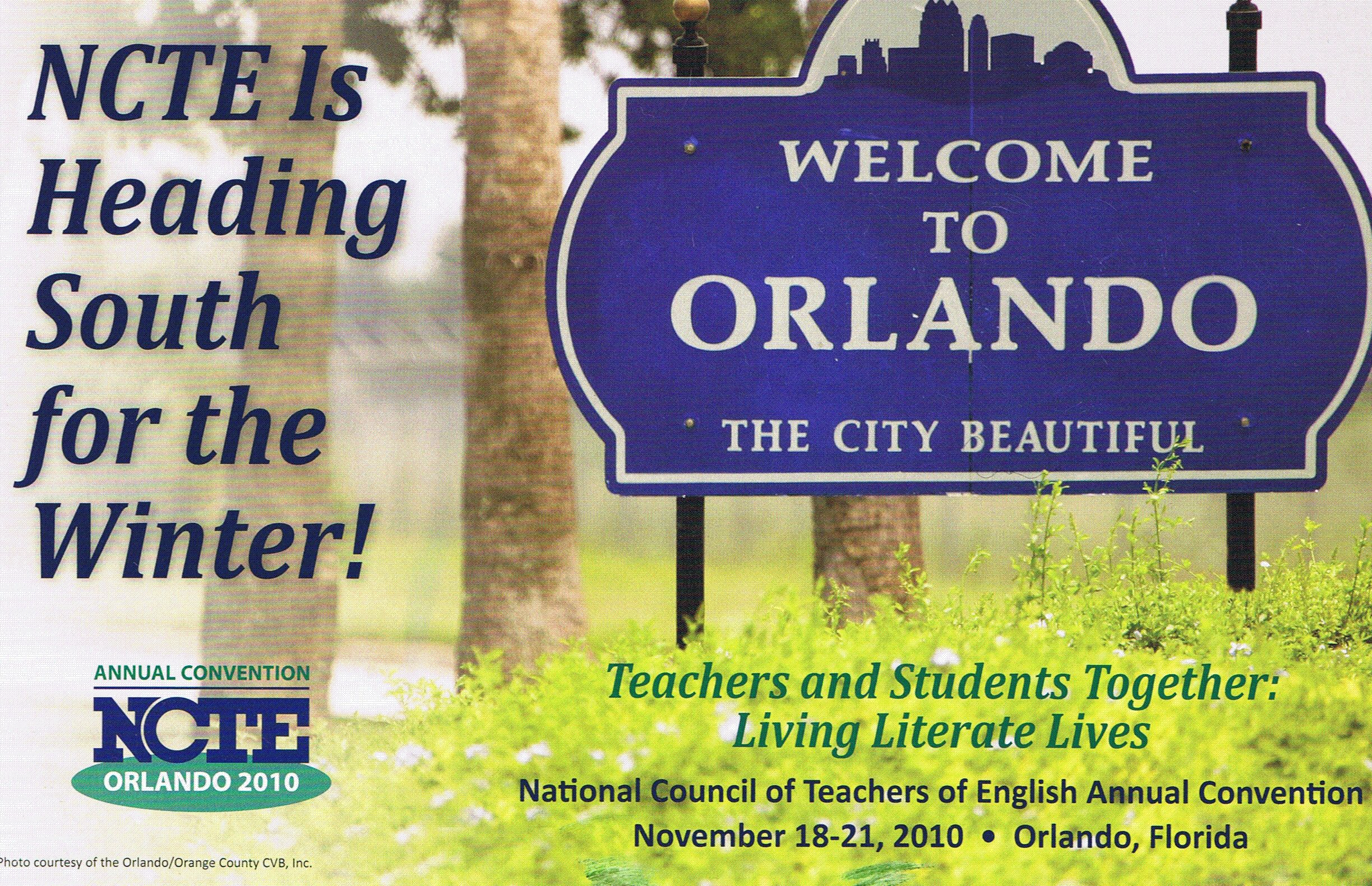
NCTE Postcard

In a couple of days, I’ll be Orlando-bound. I’m presenting on authentic assessment in Shakespeare with the Folger Shakespeare group. I do feel like a part of a family with those folks. If you want to check it out in person, come see the presentation on Saturday at 9:30 in the Yacht and Beach Club/Grand Harbor Ballroom, Salon South. It’s session G.46.

Some time soon, I will be posting my presentation and any accompanying handouts, etc. here and at the NCTE Ning.

Diigo Links (weekly)

Posted from Diigo. The rest of my favorite links are here.

Folger Shakespeare Teaching Sessions at NCTE 2010

Love's Labour's LostIf you’re looking for ideas for teaching Shakespeare, you should attend the Folger Shakespeare Library’s sessions at NCTE. Folger will present five sessions, but you need not attend all five:

  • A.44, Friday, 9:30-10:45; Shakespeare Set Free Act 1: How Pre-Reading Strategies and Activities that Focus on Language Will Ease Your Students into Shakespeare. This session will briefly introduce teachers to the philosophy of the Folger Shakespeare Library and then will focus on a variety of dynamic pre-reading activities. Presenters: Mike LoMonico, Susan Biondo-Hench, Kevin Costa.
  • B.45, Friday, 11:00-12:15; Shakespeare Set Free Act 2: How Getting Students on Their Feet and Working with Shakespeare’s Language is Easier than it Sounds. Getting your students up on their feet is an essential way to engage them with Shakespeare. The presenters will demonstrate a variety of activities to ease the transition from seat-based learning to performance-based learning. Presenters: Robert Young, Julia Perlowski.
  • C.43, Friday, 12:30-1:45; Shakespeare Set Free Act 3: How Internet-Based Web 2.0 Tools Can Get Your Students Closer to Shakespeare’s Texts. The presenters will demonstrate several Web 2.0 activities for teaching Shakespeare developed with the Folger Library. Attendees will be given tech tools to assist students in a close reading of Shakespeare’s texts. Presenters: Mike LoMonico, Scott O’Neil, Chris Shamburg.
  • F.48, Saturday, 8:00-9:15; Shakespeare set Free Act 4: How to Use Film and Video in an Active Way to Connect Your Students and Shakespeare’s Plays. We all use film when we teach Shakespeare. This session will demonstrate how using YouTube, viewing multiple versions of the same scene, and creating video trailers can make film an active rather than passive experience. Presenters: Robert Young, Joshua Cabat, Mike LoMonico.
  • G.46, Saturday, 9:30-10:45; Shakespeare Set Free Act 5: How to Create Meaningful and Authentic Assessments for Your Shakespeare Unit. As your unit winds down, you look for activities that go beyond making Globe Theater models out of popsicle sticks. The presenters will demonstrate several strategies that employ higher-level thinking to evaluate students. Presenters: Mike LoMonico, Dana Huff, Robert Young, Carol Kelly.

Yes, I’m presenting that last session, and it would be nice to see friendly faces, so please do come.

If you work with teacher candidates, you might also enjoy session M.39, Sunday, 11:30-12:45; Teaching Teachers to Teach Shakespeare. The panel will present their philosophy and some practical tools for integrating the teaching of Shakespeare into pre-service English Methods courses. The speakers will focus on current best practices developed by Folger Shakespeare Library’s Education Department and teachers who they have worked with. Presenters: Robert Young, Mike LoMonico, Glenda Funk, Peggy O’Brien, Rick Vanderwall.

See you at NCTE.

Creative Commons License photo credit: UMTAD

Diigo Links (weekly)

Posted from Diigo. The rest of my favorite links are here.

Folger Shakespeare Library Blog Post

You can read my blog post “I Noticed…” at the Folger Shakespeare Library blog Making a Scene. I have written about this technique before, but if you’re interesting in checking it out, it makes a great formative assessment.

Diigo Links (weekly)

Posted from Diigo. The rest of my favorite links are here.

Teach Episode 1 Review

Watch the first episode of Teach below.

Tony Danza and I made the same mistake. The first day I took over a class as student teacher, I did all the talking. I was hoarse at the end of the day. My mentor teacher never said anything directly to me. She quietly put a cough drop in my hand. The message couldn’t have been clearer. It made me wonder how common that mistake is. Did you do it, too?

One of the things I like about this show so far is the respect Danza shows toward teachers and teaching. It is a hard job. I like his principal. I like the fact that she feels strongly about her students’ education and leveled with Danza from the get-go. One of the things you don’t see in a series like this, however, is that as hard as teaching just one class is, or having one prep is, having five or more is that much more difficult. I have five different preps right now, five different classes. I have always had at least two preps when I have taught high school (I had one prep when I taught middle school). I do like that this program shows how difficult teaching is. I will keep watching, I think. It seems to be one of the more interesting, honest programs about teaching that I’ve seen.

Some Questions

sensitive noise / obvious 2I work in a private school and don’t have any plans to change that—certainly not anytime soon. I feel like I am on the sidelines in this great education debate. I see the comments on Twitter and read the blogs. But I have some questions.

If teachers’ unions are horrible organizations who protect bad teachers from being fired, why don’t all the students without teachers’ unions, including my own, outperform states with unions? One would think that if the unions are the problem, then states without them would have the best teachers in place, and therefore would have the highest test scores.

Why are we doing this to kids?

Why does everyone think charter schools are the answer? One where I interviewed some years ago wanted to pay me about $7,000 a year less than I was making at the time. Surely they’re not going to attract the best teachers if they will not pay the teachers a wage commensurate with what they could make elsewhere… right?

If testing kids is the answer for teacher accountability, why is it that my school’s students have managed to be as successful in college and work as students with this testing background when we only administer the PSAT and AP tests? (We encourage SAT and/or ACT.) I mean, shouldn’t it follow that my colleagues and I aren’t really being held accountable enough and that our students might somehow be slipping through the cracks?

What am I missing?

Creative Commons License photo credit: milos milosevic

Georgia DOE Excellence Recognition Program

The Georgia DOE recognized me for being the Georgia Council of Teachers of English High School Teacher of the Year.

State Superintendent Brad Bryant, me, and Sixth Congressional District Board Member Robert "Buzz" Law

It was a nice ceremony, mainly because the announcers took time to tell the audience all about the people being recognized. Often it seems these kinds of things are a blitz of names, and you don’t really have an understanding why anyone is being recognized. You can view other pictures from the event here. You should have seen the student writers being recognized for being state winners of the Georgia Young Authors Writing Competition. The young ones were especially cute. I liked hearing about the stories they wrote.

The DOE also recognized two other English teachers, winners of USDA awards for school nutrition, the School Bus Technician of the Year, and winners of Georgia Association of Educational Leaders awards. I was honored to be in such company, especially the student writers.

Issues, ideas, and discussion in English Education and Technology